Sewer Line Repair and Wastewater Review in Honolulu
Sewer work in Honolulu sits at the point where private property, public infrastructure, health protection, permitting, and licensed trade practice all meet. A clogged kitchen drain can be a simple service call. A damaged building sewer, a new connection, or a change to drainage piping is a different matter. The difference is not just cost or equipment. It is responsibility.
The City and County of Honolulu regulates plumbing systems through its plumbing code. That code applies broadly to the design, installation, alteration, repair, relocation, replacement, addition, use, and maintenance of plumbing systems. In practical terms, sewer line repair is not treated as casual handyman work. It is plumbing work, and plumbing work in Honolulu has rules around who may perform it, when permits are needed, and how the work is reviewed.
For property owners, managers, and business operators, the most important lesson is simple: diagnose carefully before digging, verify licensing before hiring, and understand that wastewater review may be part of the job before anyone cuts pipe or opens a trench. A good plumber in Honolulu does more than clear a stoppage. The right professional helps determine whether the problem is a maintenance issue, a code issue, a permitting issue, or a combination of all three.
Why sewer line repair deserves more attention than a typical service call
Many plumbing problems are visible. A leaking shutoff valve drips into a cabinet. A water heater repair issue may show up as no hot water, unusual noise, or water around the unit. Drain cleaning often starts with a sink, shower, or floor drain that backs up. Sewer trouble can be less obvious at first, and the consequences can be more disruptive.
A sewer line serves a basic public health function. It carries wastewater away from fixtures and into the larger wastewater system. When that line is damaged, poorly altered, incorrectly connected, or repeatedly obstructed, the result is not merely inconvenience. The condition can affect building use, sanitation, tenant operations, and the city’s sewer infrastructure.
That is why Honolulu’s rules matter. The local plumbing code does not only govern new construction. It also reaches repair, alteration, relocation, replacement, use, and maintenance of plumbing systems. This broad scope is important because many sewer problems begin as “just a repair” and become something larger once the line is exposed or inspected.
A property owner may call for drain cleaning because several fixtures are slow. The plumber may find that the issue is not a soft blockage near a fixture but a problem in the drainage piping. If repair or replacement of drainage piping becomes necessary, the job may move into permitting territory. In Honolulu, permits are required for plumbing-related work such as installing, removing, altering, repairing, or replacing plumbing, drainage piping, fixtures, gas appliances, and water-heating or water-treating equipment. That requirement should shape how the work is planned from the beginning.
The difference between clearing a drain and repairing a sewer line
The phrase “sewer line repair” often gets used loosely. In the field, the first task is to separate symptoms from causes. A stoppage is a symptom. A damaged or altered pipe is a condition. Wastewater review is part of the process when the work touches connection, capacity, permitting, or sewer infrastructure concerns.
Drain cleaning may restore flow if the problem is an obstruction that can be removed without changing the piping. Sewer line repair, by contrast, can involve repairing or replacing a section of drainage piping, changing an existing configuration, or addressing a connection issue. Those actions fall much closer to regulated plumbing work than routine clearing of a fixture drain.
This distinction matters when a property owner searches for “plumber near me” and wants the fastest response. Speed helps, especially when wastewater is involved, but speed should not replace judgment. An emergency plumber can stabilize a situation, protect the property, and determine whether additional permitted work is required. The best outcome is not always the quickest possible opening of the line. It is the repair that restores service while respecting code, licensing, and city review requirements.
One common mistake is treating repeated backups as separate events. A line backs up, someone clears it, the tenant returns to normal use, and everyone hopes the problem is gone. If the same issue returns, the building owner should slow down and reassess. Repeated symptoms often justify a closer look by a licensed plumber, especially if the next step could involve drainage piping repair or replacement. In Honolulu, the regulatory framework makes that distinction more than a technicality.
Permits, licensing, and the role of the City and County of Honolulu
Honolulu’s plumbing code governs the design and work performed on plumbing systems. The City and County also requires permits for a broad range of plumbing-related work, including installation, removal, alteration, repair, or replacement of plumbing and drainage piping. That means sewer line repair should be approached with an assumption that permitting may be required, not as an afterthought once work has already started.
The Department of Planning and Permitting states that electrical and plumbing work must be performed by contractors licensed by the State of Hawaii. This is not merely a preference or a mark of professionalism. It is part of how the city controls the quality and accountability of work that can affect water, drainage, wastewater, and public safety.
Hawaii’s professional licensing system includes the Board of Electricians and Plumbers, and the state provides an online database where license status, expiration dates, and disciplinary history can be checked. A property owner does not need to be an expert in plumbing law to use that safeguard. Before authorizing sewer work, especially work involving repair or replacement of drainage piping, it is reasonable to confirm that the contractor is properly licensed and in good standing.
The Honolulu plumbing code also allows the authority having jurisdiction to verify that inspected work was performed by a licensed plumbing journey worker and/or contractor. That detail is worth noting. It means licensing can matter not only at hiring but also during inspection and review. If the job is performed by someone who is not properly licensed, the issue may not surface until a critical moment, when an inspection, permit closeout, property transaction, or tenant improvement schedule is already under pressure.
Wastewater review is not red tape when the sewer system is involved
Wastewater review can feel abstract to owners who simply want a pipe fixed. From the city’s perspective, sewer infrastructure must be protected. Honolulu wastewater guidance emphasizes protecting sewer infrastructure and notes that sewer connection and related wastewater issues involve city review and permitting processes. That is the frame owners should keep in mind.
A sewer connection is not just a private convenience. It links a building to a public system. When work changes that connection or affects drainage piping tied to it, city review helps confirm that the work is handled within the rules. This is especially important for commercial properties, multi-tenant buildings, and projects that involve new or changed use. A commercial plumber who understands review procedures can help prevent a repair from turning into a compliance problem.
The review process is also a reminder that plumbing systems do not exist in isolation. Water service, drainage, wastewater, and building use can overlap. The Honolulu Board of Water Supply handles water-service and permitting-related matters for projects, and large commercial developments often require master plans and more complex review of water-system capacity. That is a water-service context rather than a sewer repair instruction, but it reflects a broader truth: larger projects often require more coordination than a simple service call.
A small residential repair and a large commercial alteration do not carry the same review burden. The judgment lies in identifying which situation you actually have. A licensed plumber Oahu property owners rely on should be able to explain when a repair appears straightforward and when the work may trigger permit, inspection, or wastewater review considerations.
What property owners should ask before approving sewer work
A sewer problem can create urgency, and urgency can make owners skip basic questions. That is risky. The better approach is to ask focused questions early, before excavation, replacement, or alteration begins. You are not trying to micromanage the plumber. You are confirming that the work is being handled with the right level of care.
The most useful questions are direct:
- Are you licensed by the State of Hawaii for this type of plumbing work?
- Does this repair require a City and County of Honolulu plumbing permit?
- Will the work alter, repair, replace, or relocate drainage piping?
- Could this involve a sewer connection or wastewater review?
- Who will be responsible for inspection coordination and permit closeout?
Those five questions reveal a lot. A qualified plumber Honolulu property owners can trust should not be irritated by them. On the contrary, clear questions help define scope, pricing, timing, and responsibility. If a contractor dismisses permitting without understanding the exact work, or discourages license verification, that is a warning sign.
The answer may still be nuanced. Not every service visit requires the same process. Not every drain cleaning call becomes a sewer line repair. But if the job involves installing, removing, altering, repairing, or replacing drainage piping, the Honolulu permit requirement must be considered. The contractor should be able to speak plainly about that distinction.
Residential sewer line repair: practical expectations
For homeowners, sewer trouble often begins with a disruption to daily life. Fixtures drain slowly, wastewater appears where it should not, or a recurring stoppage makes the home difficult to use. The natural instinct is to search for a plumber near me and ask for the soonest appointment. That is reasonable, especially when the problem affects sanitation.
The first visit should establish whether the issue can be addressed as a service problem or whether it points toward repair of the drainage system. A professional plumber will gather information before promising a permanent fix. Which fixtures are affected? Is the issue isolated or building-wide? Has it happened before? Has recent plumbing work been done? Are there signs that drainage piping has been altered or repaired previously?
The answers shape the next step. If the problem is limited and can be cleared through drain cleaning, the job may remain a maintenance call. If the line cannot be restored reliably without repairing or replacing drainage piping, the owner should expect a different conversation. At that point, the focus shifts to permitting, licensing, code compliance, and possibly city review.
Homeowners sometimes worry that mentioning permits will make a repair slower or more expensive. It can add process, but avoiding required permits creates a different kind of risk. Unpermitted plumbing work can become a problem during inspections, remodels, insurance discussions, or future sale of the property. More importantly, sewer and drainage systems affect health and infrastructure. The permit process exists because the work matters.
Commercial properties and higher stakes
Commercial sewer line repair tends to carry more moving parts. A restaurant, clinic, retail center, office building, or multi-tenant emergency commercial plumber property may depend on functioning plumbing to remain open. A backup can affect customers, employees, tenants, lease obligations, and sanitation procedures. A commercial plumber must balance immediate response with code and permitting obligations.
The scope can also be harder to define. Commercial buildings often include more fixtures, more complex drainage layouts, and more users. A symptom that appears in one area may reflect a larger issue in shared drainage piping. If the work involves alteration, repair, or replacement, the same Honolulu permit framework applies. If sewer connection or wastewater concerns are implicated, city review may be part of the path forward.
Large commercial developments add another layer. The Honolulu Board of Water Supply notes that large commercial developments often require master plans and more complex review of water-system capacity. While that point concerns water-system capacity rather than ordinary sewer repair, commercial owners should take the lesson seriously: larger projects demand early coordination. A repair tied to a broader renovation, change in use, or building improvement may need more than a service invoice and a handshake.
For property managers, documentation is not busywork. Keep records of who performed the work, license information, permit status, inspection results, and the final scope. If a tenant later reports a related issue, or if the building undergoes additional improvements, those records help everyone understand what was done and what remains.
Emergency sewer calls: stabilize first, then solve correctly
An emergency plumber is often called when there is no time for a long planning meeting. Wastewater may be backing up. Tenants may be calling. A business may be trying to avoid closing for the day. In that moment, the first objective is stabilization. Stop active damage where possible, restore safe use if appropriate, and determine whether the building can continue operating.
Emergency response, however, does not erase Honolulu’s plumbing requirements. If the permanent fix involves repairing or replacing drainage piping, permitting still needs to be addressed. A qualified emergency plumber should be able to separate temporary response from permanent repair. That distinction protects the owner as much as the contractor.
A rushed permanent repair can create future trouble if it bypasses permit requirements or ignores wastewater review. Conversely, waiting too long to stabilize a wastewater problem can create health and property concerns. The practical balance is to make the site safe, document the condition, communicate clearly about next steps, and move any regulated repair into the proper process.
The most professional emergency calls often end with two scopes: immediate mitigation and permanent correction. The first may involve restoring temporary function or preventing further impact. The second may require permitted repair, inspection, or review. Owners should ask for that distinction in writing when the situation allows.
Leak detection, water heater repair, and why sewer work is different
Many plumbing services are related through licensing and code requirements, even when the technical work differs. Leak detection, water heater repair, drain cleaning, and sewer line repair all fall under the broader world of plumbing service. In Honolulu, plumbing work generally sits within the city’s plumbing code and permit framework when it involves regulated installation, repair, alteration, replacement, and related activities.
Still, sewer line repair has a distinct character. Leak detection may focus on finding hidden water loss. Water heater repair may involve water-heating equipment, which is specifically within the category of plumbing-related work for which permits may be required when installing, removing, altering, repairing, or replacing such equipment. Drain cleaning may be a maintenance task unless it reveals the need to change piping. Sewer work, especially when it touches drainage piping or connections, can quickly involve both plumbing code and wastewater review concerns.
The trade-off is practical. A broad-service plumber can be valuable because problems do not always arrive in neat categories. A call that begins as leak detection may uncover a drainage issue. A water heater replacement may involve code and permit questions. A drain cleaning call may become sewer line repair. The owner benefits from a professional who can identify the correct category of work and explain the regulatory path.
How to evaluate a plumber in Honolulu for sewer-related work
Hiring for sewer work should not be based on price alone. Price matters, particularly when excavation or replacement is involved, but the cheapest proposal can become expensive if licensing, permitting, or inspection issues are mishandled. The better measure is whether the contractor understands the job technically and procedurally.
A strong proposal for sewer line repair should describe the condition being addressed, the work to be performed, and whether the work involves drainage piping repair, alteration, replacement, or connection issues. It should identify who is responsible for permits and inspection coordination. It should also come from a contractor whose State of Hawaii license can be verified.
When comparing plumbers, look for these signs of professionalism:
- They encourage license verification and provide accurate identifying information.
- They explain whether the job appears to require a Honolulu plumbing permit.
- They distinguish between drain cleaning, temporary service, and permanent sewer repair.
- They discuss wastewater review when sewer connection issues may be involved.
- They document scope changes before performing additional regulated work.
That list is short because the principle is simple. The contractor should make the regulatory side clearer, not murkier. A plumber who treats permits as a nuisance may not be the right person for sewer work in Honolulu. A plumber who knows when to involve the City and County process can save time, even if the process itself adds steps.
The owner’s role in a smooth repair
Owners and managers sometimes assume that compliance is entirely the contractor’s problem. In day-to-day terms, the contractor performs the work and handles the technical requirements. But the owner controls access, budget, approvals, records, and often the decision to proceed. That means the owner’s choices can either support or undermine a smooth repair.
Start by describing the problem honestly. If backups have happened before, say so. If previous plumbing work was done, provide records if you have them. If the property is commercial and operations are time-sensitive, explain the constraints at the beginning. A plumber cannot plan well with partial information.
Next, avoid pushing for a permanent fix before diagnosis. Sewer problems can look similar from the surface. Slow drains, odors, and backups do not automatically prove that a line needs replacement, but repeated or widespread symptoms should not be ignored. Let the licensed professional determine whether the work is service, repair, alteration, or replacement.
Finally, treat documentation as part of the job. Keep copies of permits, inspection records, invoices, and final descriptions of work performed. If wastewater review or sewer connection approval is involved, keep those records with the property file. Good documentation protects future owners, managers, tenants, and contractors from guessing.
When a repair becomes part of a larger project
Sewer line repair sometimes happens during remodels, tenant improvements, additions, or changes to building use. At that point, the repair may no longer be an isolated plumbing event. The project may involve broader design, permitting, water-service review, and wastewater considerations.
The Honolulu Board of Water Supply handles water-service and permitting-related matters for projects. For large commercial developments, master plans and more complex review of water-system capacity may be required. That does not mean every sewer repair becomes a master planning exercise. It means owners should recognize the difference between a limited repair and a project that changes demand, layout, or system relationships.
A commercial property owner planning improvements should bring plumbing questions forward early. Waiting until construction has begun can create expensive delays if drainage piping, fixtures, water-heating equipment, or sewer connections require permits or review. The same is true for residential projects that involve changes to plumbing systems. Honolulu’s plumbing code applies to design, installation, alteration, repair, relocation, replacement, addition, use, and maintenance. That scope is wide enough that plumbing should never be an afterthought in planning.
A capable plumber Oahu owners hire for project work should coordinate with the permitting path, not simply show up after walls are open. The earlier the plumbing scope is defined, the easier it is to avoid rework.
Practical judgment: not every problem needs the biggest solution
Professional plumbing requires judgment. Overreacting can waste money. Underreacting can leave a property exposed to repeated failures and compliance risk. The challenge is to match the response to the actual condition.
If a single fixture drains slowly, the first answer may be straightforward drain cleaning. If multiple fixtures are affected or the same problem returns, the plumber should consider whether the issue lies deeper in the drainage system. If repair, replacement, relocation, or alteration of drainage piping is needed, Honolulu’s permit requirements enter the conversation. If sewer connection or wastewater infrastructure concerns are involved, city review may become part of the process.
The owner should expect plain language. A contractor does not need to turn every service call into a code lecture, but should be able to say, “This is maintenance,” or “This is now a drainage piping repair,” or “We need to check permit requirements before proceeding.” Those distinctions are the mark of an experienced professional.
The same judgment applies to timing. Emergency work may need immediate action. Non-emergency work may benefit from planning, permit coordination, and careful scheduling. Commercial work may need off-hours coordination or phased access, while residential work may center on restoring basic household function. The code framework stays the same, but the practical execution changes with the property.
Protecting the sewer system protects the property
Honolulu’s wastewater guidance emphasizes protecting sewer infrastructure. That principle can sound distant until a property experiences a sewer failure. Then the connection becomes clear. Private plumbing choices affect public systems, and public system requirements affect private repairs.
Sewer line repair is therefore both a trade task and a civic responsibility. Licensed plumbers, city reviewers, inspectors, owners, and managers each play a part. The rules are not separate from the work. They are part of how the work is made safe, traceable, and durable.
For owners, the best approach is steady and practical. Use a properly licensed State of Hawaii contractor. Verify license status when the scope justifies it. Ask whether the work requires a City and County of Honolulu plumbing permit. Recognize that sewer connection and wastewater issues may involve review and permitting. Keep records. Do not confuse a cleared drain with a repaired sewer line unless the evidence supports it.
A reliable plumber Honolulu residents and businesses can depend on will respect those steps. Whether the call involves drain cleaning, leak detection, water heater repair, emergency plumber response, or full sewer line repair, the professional standard is the same: understand the system, follow the code, protect the property, and leave a record that stands up later.
Name: P&S Plumbing
Address: 1714 Homerule St Bay 1, Honolulu, HI 96819, United States
Phone: 808-842-0345
Website: https://www.psplumbinghawaii.com/locations/honolulu/
Email: [email protected]
Hours:
Sunday: Open 24 hours
Monday: Open 24 hours
Tuesday: Open 24 hours
Wednesday: Open 24 hours
Thursday: Open 24 hours
Friday: Open 24 hours
Saturday: Open 24 hours
Time zone: Hawaii-Aleutian Time
Open-location code / Plus code: 84F8+HP Honolulu, Hawaii, USA
Map/listing URL: https://www.google.com/maps/search/?api=1&query=Google&query_place_id=ChIJl_3qEMhvAHwRtgTEMKE27zE
Embed iframe:
Socials:
https://www.facebook.com/psplumbinghonolulu/
https://x.com/PSPlumbingoahu
https://www.youtube.com/@PSPlumbingHonolulu/
https://soundcloud.com/p-s-plumbing-honolulu
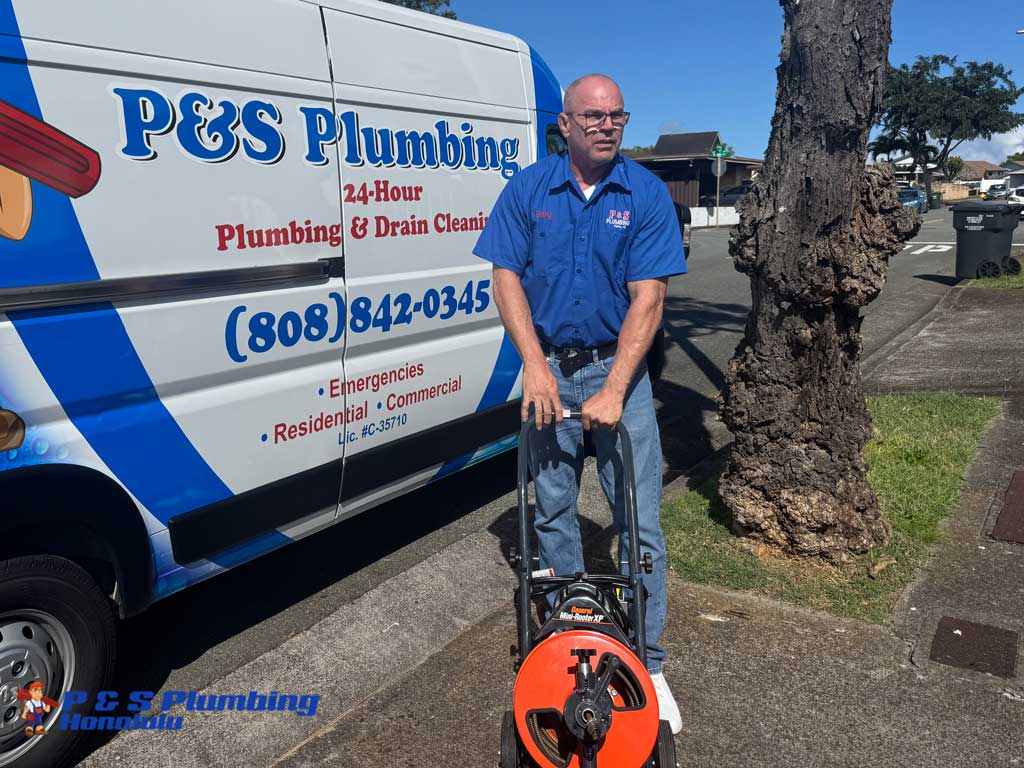
P&S Plumbing provides plumbing services from its Honolulu location on Homerule Street.
The official Honolulu page lists drain cleaning, plumbing repairs, water heater repair, water heater installation, sewer line repair, and 24-hour emergency plumbing services.
P&S Plumbing serves residential and commercial customers across Honolulu and Oahu, including Kalihi, Kakaako, Ala Moana, Waikiki, Moiliili, Makiki, Manoa, Aliamanu, Aiea, Pearl City, Waipahu, Ewa Beach, Kapolei, Hawaii Kai, and nearby communities.
The Honolulu shop is listed at 1714 Homerule St Bay 1, Honolulu, HI 96819, near Kalihi and local routes serving central Honolulu.
The official website lists Hawaii State License Number CT-35710 and describes the company as licensed and insured.
Customers can contact P&S Plumbing for drain cleaning, hydro jetting, leak detection, water heater service, sewer line repair, fixture repair and installation, kitchen plumbing, bathroom plumbing, commercial plumbing, residential plumbing, and emergency plumbing needs.
For plumbing service in Honolulu and Oahu, call 808-842-0345 or visit https://www.psplumbinghawaii.com/locations/honolulu/
The public map listing uses plus code 84F8+HP Honolulu, Hawaii, USA and can help customers find P&S Plumbing near Homerule Street in Honolulu.
Popular Questions About P&S Plumbing
What does P&S Plumbing provide in Honolulu?
P&S Plumbing provides drain cleaning, plumbing repairs, water heater repair and installation, sewer line repair, hydro jetting, leak detection, fixture repair and installation, bathroom plumbing, kitchen plumbing, residential plumbing, commercial plumbing, and 24-hour emergency plumbing services.
Where is P&S Plumbing located in Honolulu?
P&S Plumbing is listed at 1714 Homerule St Bay 1, Honolulu, HI 96819, United States. The official website also lists the address as 1714 Homerule Street 1, Honolulu, HI 96819.
What phone number should Honolulu customers call?
The official Honolulu page and contact page list 808-842-0345 for Honolulu-Oahu service.
What is the email address for P&S Plumbing?
The email address is [email protected].
What are P&S Plumbing’s Honolulu hours?
The official Honolulu page and supplied listing show P&S Plumbing as open 24 hours a day, seven days a week, Hawaii-Aleutian Time.
Is P&S Plumbing licensed?
The official Honolulu page lists Hawaii State License Number CT-35710. Customers can confirm license status directly with the relevant Hawaii licensing authority before hiring.
Does P&S Plumbing offer emergency plumbing in Honolulu?
Yes. The official Honolulu page lists 24-hour emergency plumbing services for urgent plumbing issues.
Does P&S Plumbing handle water heaters?
Yes. The official Honolulu page lists water heater repair, water heater installation, tankless water heater installation, solar water heater installation, and traditional water heater installation.
Does P&S Plumbing provide commercial plumbing?
Yes. The official Honolulu page lists commercial plumbing services along with residential plumbing services.
How do I contact P&S Plumbing?
Call 808-842-0345, visit https://www.psplumbinghawaii.com/locations/honolulu/, or use the map URL: https://www.google.com/maps/search/?api=1&query=Google&query_place_id=ChIJl_3qEMhvAHwRtgTEMKE27zE. Social profiles: Facebook, X, YouTube, and SoundCloud.
Landmarks Near Honolulu, HI
Homerule Street: The street listed for P&S Plumbing’s Honolulu location and a practical reference point for finding the shop.
Kalihi: A central Honolulu area near Homerule Street with homes, businesses, warehouses, and local service routes.
Dillingham Boulevard: A major nearby corridor serving Kalihi, Iwilei, Honolulu Harbor, and surrounding business areas.
Nimitz Highway: A key Honolulu route connecting the airport, harbor, downtown, and central business districts.
H-1 Freeway: A major Oahu highway used to reach Honolulu neighborhoods and communities across the island.
Honolulu Harbor: A major commercial waterfront landmark near downtown and industrial service areas.
Daniel K. Inouye International Airport: A major transportation landmark west of central Honolulu and near key Oahu service routes.
Downtown Honolulu: A central business and residential district served by local plumbing contractors.
Chinatown Honolulu: A nearby historic district with restaurants, shops, apartments, and older plumbing infrastructure.
Iwilei: A nearby commercial and industrial area with warehouses, retail properties, and service businesses.
Kakaʻako: A growing residential, retail, and commercial district southeast of downtown Honolulu.
Ala Moana Center: A major Honolulu retail landmark and citywide reference point.
Waikiki: A major visitor, hotel, condo, and residential area within P&S Plumbing’s broader Honolulu service area.
Moanalua: A Honolulu community listed within P&S Plumbing’s broader Oahu service-area references.
Pearl Harbor area: A major Oahu landmark west of Honolulu and near residential and commercial service routes.
For drain cleaning, plumbing repairs, water heater service, sewer line repair, hydro jetting, leak detection, fixture installation, commercial plumbing, residential plumbing, or 24-hour emergency plumbing near these Honolulu and Oahu landmarks, contact P&S Plumbing at 808-842-0345 or visit https://www.psplumbinghawaii.com/locations/honolulu/